

Squid Gamebler, developed by InOut , emerged as a response to the competitive landscape in South Korea. The country is one of the most challenging geographies in the market, with strict moderation, high costs, and competitive media auctions. Classic games like Plinko were already saturated, and the public was tired of repetitive creatives.
The turning point came when the Devils Facebook Team identified the potential of Squid Gamebler amid the recent rise of Round 6 (Squid Game) in local media. The title attracted attention for combining a widely recognized narrative with more dynamic and modern mechanics than traditional crash games, becoming a turning point for digital campaigns in the country.
In Korea, Squid Game is a cultural touchstone. Everyone recognizes the visuals and memes; the setting conveys trust and instantly captures attention. For users, the content feels “native,” which increases CTR (click-through rate) and engagement compared to generic slots.
The popularity of the Squid Game keyword directly fueled the launch—players recognized the theme even at the announcement stage. As a result, campaigns gained traction faster, and the game received additional prominence in the auction.
Preparation and configuration
The team started by testing different elements of the funnel:
- Funnel Type: PWA
- Creatives: motion and UGC (User Generated Content) formats
- Release configuration: Multiple rounds of testing
Local context was crucial. In Korea, native ecosystems dominate—
Initial steps
The launch began on Facebook, with several offers tested in parallel.
- Offer 1 converted strongly from day one and became the focus of scaling.
- Offer 2 underperformed in the installation phase and was quickly discontinued.
Traffic was then redirected entirely to the PWA funnel, which allowed for full customization—a localized Squid Gamebler-style design, Korean language, local currency (KRW), and integrated bonuses. This cohesive structure kept conversion rates consistent and ROI under control.
The creative department was involved from the research stage. After analyzing what worked in similar funnels in this GEO, the designers received detailed briefings. Observing the reactions of Korean streamers, YouTubers, and influencers, they created natural UGC scripts that resonated with the audience.
Realism became the main conversion factor—honest presentation, native language, and authentic tone.
Creatives and location
Asian markets once responded well to flashy creatives, with neon lights and exaggerated gains—but that era is over. Today, realism and cultural relevance are the deciding factors.
A referral mechanism with “invite a friend” bonuses increased retention and LTV.
Two main creative formats were used:
- Motion: Simple demonstrations of gameplay and genuine emotions of victory.
- UGC: Realistic smartphone gameplay, authentic reactions, and full localization (language + currency).
Authenticity was the key principle—no fake jackpots, just moderate, credible winnings. This transparency built trust and improved funnel performance.
Creative names were shared with the partner for cross-tracking of ROI and quality metrics. When performance stabilized, the affiliate department confirmed the results before the partner even returned, resulting in a +$20 fee increase and a direct improvement in overall savings.
Optimization and strategy
The team prioritized their KPIs in order: CPI (cost per install), CPR (cost per registration), and CR (conversion rate), considering ROI and CPD as resulting metrics.
The budgeting strategy used the Campaign Budget Optimization (CBO) model. Since most traffic occurs at night, manual bid control (ABO) carried the risk of overspending. With CBO, Facebook automatically distributed the budget across ad sets, optimizing conversions.
Targeting remained broad: all of South Korea, 21 and older, all genders. Language and interests remained open—no keywords like “casino” or “gambling” were used to limit the audience. The creative itself acted as the primary filter, allowing the algorithms to discover new conversion segments.
The budget mechanics followed the 1–3–1 principle:
1 campaign → 3 ad sets → 1 ad per set.
This structure improved algorithm learning and signal clarity. Scaling occurred through gradual budget increases (+10–20% daily) and duplicating campaigns across different accounts, expanding reach without increasing frequency.
As a result, traffic volume grew steadily while maintaining efficient CPI and CR metrics.
Moderation challenges
Korean moderation is one of the strictest. Initially, Squid Gamebler‘s creatives passed review easily, but after a few days, they began to be rejected. To extend the campaigns’ lifespan, the team used neutral video previews, which helped bypass automatic filters—a temporary but effective solution.
The creative teams quickly produced new batches of UGC and motion ads with updated scripts and localized styling. Constant rotation and production speed kept the campaigns moving and healthy.
Performance and stability
Conversion rates in Korea tend to fluctuate—due to payment systems, user behavior, or market trends. The team evaluated performance over longer periods, focusing on ROI consistency rather than daily spikes.
This approach ensured KPIs were met and campaigns remained profitable until creatives ran out and competition increased.
Summary
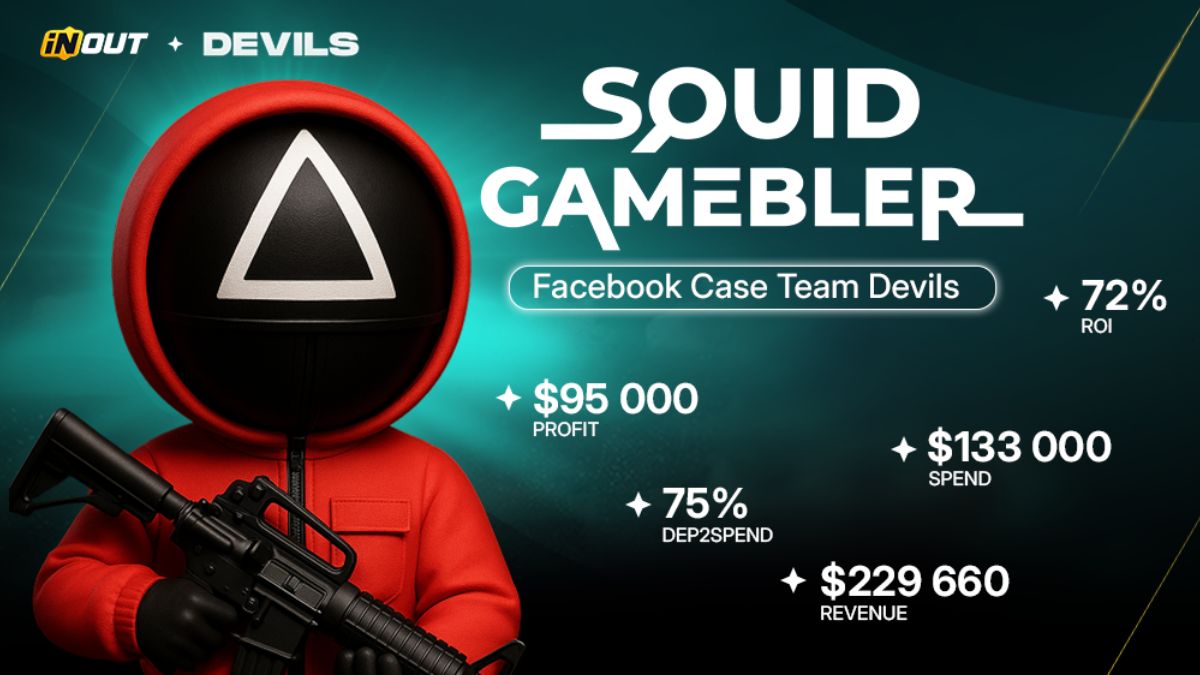
Over 30 days, the campaign recorded:
- FTD: 1.098
- Revenue: US$ 229.660
- Profit: US$ 95.000
- Expenses: US$ 133.000
- Deposits: US$ 176.193
- ROI: 72%
- DEP2SPEND: 75%
The results confirmed the stability and high quality of traffic, validating the effectiveness of the creative strategy and localization.
Squid Gamebler brought triggers that immediately resonated with users: a recognizable setting, simple mechanics, and appealing visuals for the algorithms. For a small geographic region like Korea, this combination was ideal—fast entry, high engagement, and sustainable performance.
For game integration inquiries, contact the InOut Games team.