


Brazil is not only the main hub of the iGaming industry in Latin America, but also the market that most depends on mobile devices to sustain its operation. A recent survey carried out by the Aposta Legal platform reveals that the use of cell phones in betting has reached unprecedented levels on the national scene.
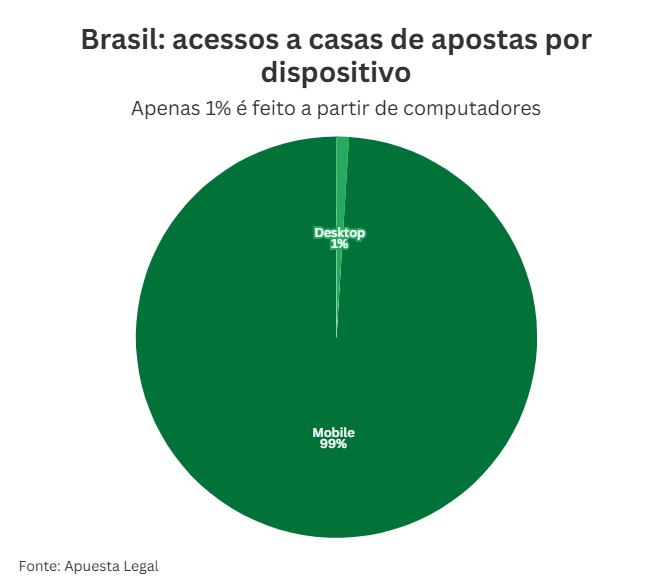
According to data captured by the Bets Panel during the first quarter of 2026, an impressive 98.64% of accesses to betting houses were made via smartphones.
Meanwhile, the use of desktop computers has become almost residual and has practically disappeared from the Brazilian consumer’s digital journey.

How the use of cell phones in betting transformed the country into a “mobile-only” market
Unlike other global markets where the desktop still divides the user’s attention and maintains a certain relevance, the betting culture in Brazil has grown and solidified in a way closely linked to the smartphone.
This expansion accompanied the boom in social networks, the popularization of applications, the development of highly responsive websites and the consumption of sports broadcasts in real time.
Today, the mobile device is the main gateway for registrations, deposits, checking dynamic quotes and quick withdrawals.
This behavior explains, to a large extent, why the national operation operates on a logic of extremely high frequency and volume.
As the user is online all the time, their entertainment no longer depends on a specific moment of the day and starts to be organically integrated into their routine, which brings Brazil closer to a standard almost exclusively focused on the small screen.

The strength of absolute numbers and the contrast with South American neighbors
When we analyze the absolute numbers for the first three months of 2026, the dimension of this disparity becomes even clearer.
The country recorded a total of 6.28 billion general accesses, of which almost 6.19 billion came from mobile browsing.
The desktop had around 85.4 million visits. This volume, although considerable in isolation, represents only 1.36% of the gigantic share of the domestic market.
The local characteristic becomes even more evident when comparing the behavior with other countries monitored in the region.
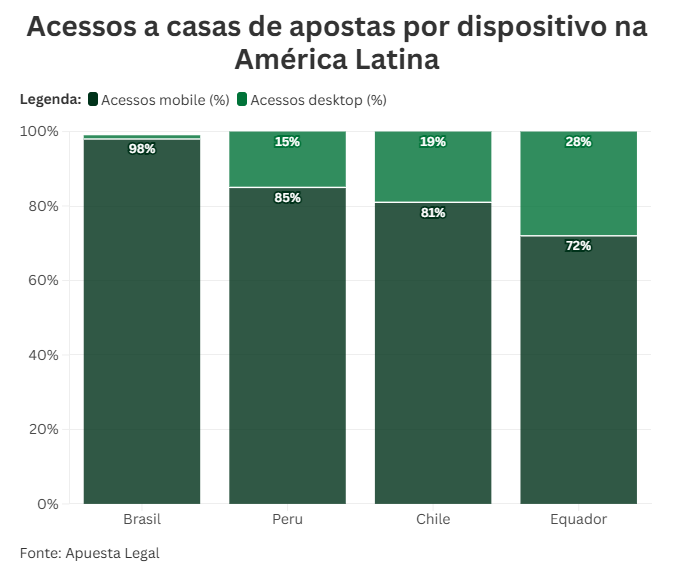
While Brazil concentrates almost everything on the mobile environment, Peru has a 15% share on computers (compared to 85% via cell phones).
In Chile, the desktop accounts for 19% of accesses and, in Ecuador, it reaches a significant 28%.
In proportional terms, the weight of computers in Chilean operations is almost 14 times greater than in Brazil, jumping to 20 times in the Ecuadorian case.
Adding this behavior to a chasm in the total scale of visits (Peru registered 253 million, Chile 72.38 million and Ecuador 15.28 million), the message for sports houses is that focusing on the mobile product is not just a stage of development; In Brazil, it represents absolutely the entire market.