


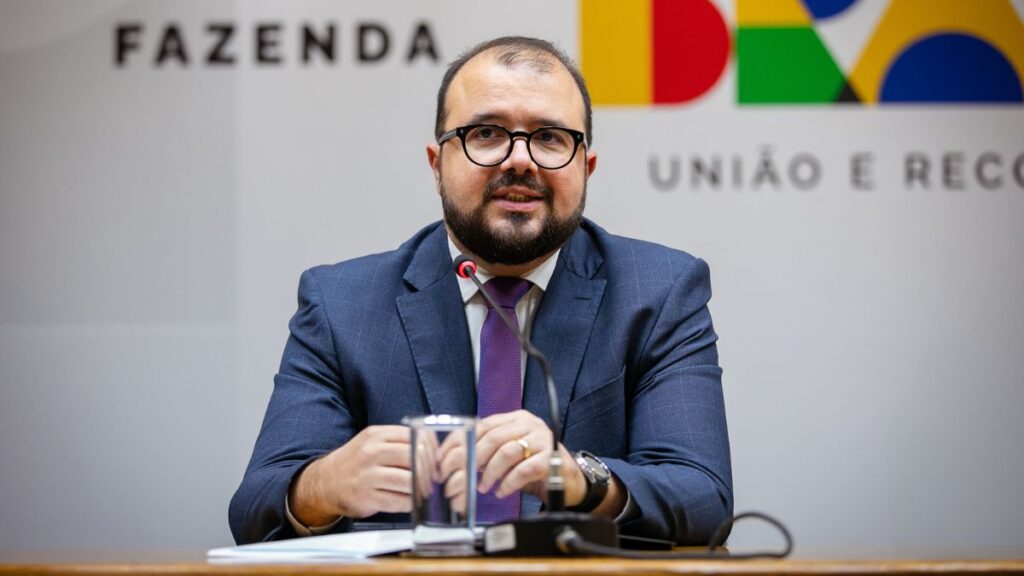
The Secretary of Prizes and Betting at the Ministry of Treasury, Regis Dudena, stated that Brazil considers online betting a public service, not a private activity with free competition. Dudena made the statement during a conference at the Higher School of Advocacy of the Brazilian Bar Association (OAB) of Minas Gerais, in Belo Horizonte.
Dudena presented the regulatory framework implemented by the department in 2024 and emphasized that protecting bettors is the direct responsibility of the operators.
He explained: “Here we are not dealing with a purely private activity of free competition. This exploitation takes place through a concession from the State. And the private sector does it as an extension of the State.”
Why does the Brazilian model consider betting as a public service?
According to the secretary, national law classifies sports betting and online games as a type of lottery, which subjects the sector to public law and the principle of administrative legality. Therefore, operation by private companies requires authorization from the State.
According to Regis Dudena, the department can deny or revoke authorization when there is doubt about the agent’s suitability or a risk to the public interest.
Therefore, he stated: “If I have a reasonable, legitimate doubt regarding the suitability of an agent, it is the administration’s duty not to grant authorization.”
“This legitimate doubt is sufficient justification for the discretionary act of refusal, because we are talking about protecting third-party resources.”
The secretary explained that the department created the regulatory framework to address two negative externalities. The first is social and economic, aimed at combating money laundering and fraud.
The second goal is to protect gamblers from pathological gambling and financial hardship. According to the secretary, the historical prohibition of the activity has not protected people.
He recalled that the country has banned gambling since 1946 and that subsequent attempts to legalize it have failed.
“What history has shown us is that prohibition has not protected people. Regulation exists to protect, including from themselves, the people who engage in this activity,” said the secretary.
Regis Dudena talks about operator responsibility and control rules.
Regis Dudena emphasized that the concept of responsible gambling does not transfer the duty of self-control to the bettor. “It’s very common to think that the expression ‘responsible gambling’ assigns responsibility to the bettor. What we, as regulators, are saying is that this responsibility lies with the betting operator,” he stated.
The Brazilian model, according to him, rejects generic time or value restrictions. Instead, it requires operators to know the profile of their clients and apply individual limits.
“Low-income youth and retired millionaires should not face the same restrictions. But both should be protected,” Dudena stated.
The regulation stipulates CPF (Brazilian Individual Taxpayer Registry) verification and facial recognition to prevent participation by minors under 18 years of age. Only financial institutions and payment institutions authorized by the Central Bank (BC) can offer services to betting sites.
“The financial service provider for betting sites in Brazil needs to be a financial institution or an authorized payment institution. Because here the regulatory bar is higher and attracts supervision from the Central Bank,” he explained.
All online games must be certified by independent laboratories authorized by the Ministry of Treasury. Dudena cited the “Jogo do Tigrinho” (Little Tiger Game), adapted to the fixed quota model, as an example of compliance.
“These games can only be offered after certification by independent laboratories authorized by the Ministry of Treasury. This ensures that the system is fair, auditable, and secure,” he said.
Authorization, combating illegality, and regulatory challenges.
The secretary informed that the process to operate as a national operator requires approximately 100 documents. After the initial analysis, there is a new stage focused on granting the license and financial matters. The authorization costs R$ 30 million, plus a protection fee of R$ 5 million.
He highlighted that, during the adaptation period foreseen in Law No. 14,790, sanctioned in 2023, the department needed to differentiate between companies willing to operate legally and those exploiting loopholes. “It was necessary to separate the wheat from the chaff—to identify who wants to operate within the law and who takes advantage of informality and crime,” he stated.
The president of the Commission on the Rights of Bets, Gambling, Games and Lotteries of the OAB-MG (Brazilian Bar Association of Minas Gerais), Frederico de Assis Faria, commented on the technical relevance of the presentation: “The meticulous explanation presented by Secretary Dudena unequivocally consolidates the understanding that the operation of fixed-odds betting legally qualifies as a granted public service, fully subject to the precepts of administrative law.
Clarity regarding the duties that are imposed, especially concerning the rigorous control of payment methods and the requirements for responsible gambling, is an indispensable condition for the sustainable development of the sector.
In this new scenario, the fundamental role of legal counsel emerges as a pillar of legal support in defending the interests of all stakeholders in the sector, whether bettors or operators,” he said.