


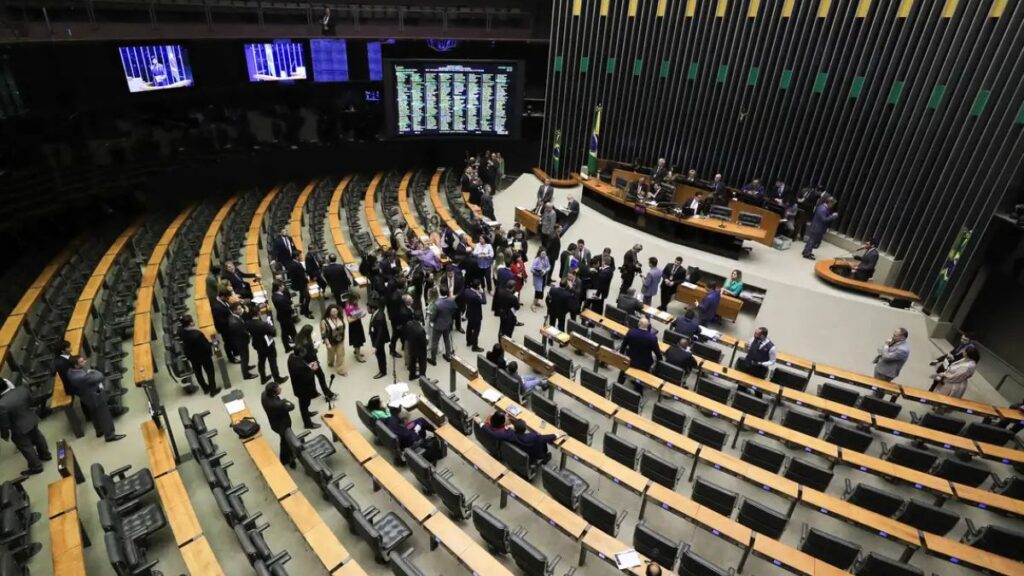
The revenue generated by the regulated online betting market (bets) remains at the center of discussions in the National Congress. After the advancement of taxation in the sector in 2025 and in the first quarter of 2026, parliamentarians began to defend new projects aimed at redistributing these resources to strategic areas. These include sports, education and public safety.
In the first three months of 2026 alone, the Federal Government collected R$3.4 billion in taxes linked to the betting sector. The value represents growth of 123.7% compared to the same period of the previous year. In 2025, the first full year of regulation, total revenue reached R$9.95 billion.
Among the proposals being processed is PL 6,124/2025, recently approved by the Senate’s Sports Commission (CEsp). The text amends Law 13,756/2018 and provides for the redistribution of part of the revenue from sports betting destined for the Ministry of Sports.
With this, a percentage of the resources would go to serve the Military Sports Commission of the Ministry of Defense. The measure seeks to strengthen programs linked to military sports in the country. Now, the project will go to the Economic Affairs Commission (CAE) for analysis.
How bet resources can finance new sports projects
Another proposal under debate is PL 6133/25, responsible for the creation of the University of Sport, in Brasília. The project has already received approval in the Chamber of Representatives and is awaiting evaluation by the Senate.
The initiative aims to expand research, academic training and scientific development focused on Brazilian sport. Furthermore, part of the planned financing will come from revenues obtained from sports betting and online games.
At the same time, the Federal Government also consolidated measures aimed at public safety. In April, the Executive issued the provisional measure for bets and defined that 3% of the sector’s revenue will go to the Fund for the Equipment and Operationalization of the Federal Police’s Core Activities (Funapol).
The text establishes a gradual implementation of the measure. Thus, the percentage will be 1% in 2026, 2% in 2027 and 3% from 2028 onwards.
The CEO of InPlaySoft, Alex Rose, highlighted: “The allocation of resources from regulated betting for the creation and maintenance of the Federal University of Sport demonstrates how regulation can generate positive and structuring impacts for the country.”
The founder and chairman of the board of Ana Gaming, Nickolas Tadeu Ribeiro de Campos, stated: “Licensed companies in the online betting sector generate jobs, collect taxes and allocate significant resources to sport, culture and the media through sponsorships and partnerships.”
Regulated market increases revenue and job creation
The sector’s numbers also reinforce the economic impact of regulated betting in Brazil. Data from the Federal Revenue indicate that in December 2025 alone the government collected more than R$1.1 billion in taxes linked to the segment. Growth exceeded 3,000% compared to December 2024.
Taxation mainly applies to gross gaming revenue (GGR), at a rate of 12%. In addition, the sector also collects charges such as PIS (Social Integration Program) and Cofins (Contribution to the Financing of Social Security).
A study commissioned by IBJR (Brazilian Institute of Responsible Gaming) from LCA Consultoria points out that the total tax burden in the sector reached 32% in 2025. Furthermore, the percentage could reach 42% by 2033, after the complete implementation of the Tax Reform.
Betlaw partner and legal consultant for ANJL (National Association of Games and Lotteries), Bernardo Cavalcanti Freire, analyzed: “The segment is one of the most taxed sectors in the country and has brought benefits to society, with resources allocated to education, sport and culture.”
In addition to revenue, the sector also generates investments and jobs. A survey by LCA Consultoria in partnership with Cruz Consulting estimates that the market currently has R$7.5 billion in invested capital. The study also points to the potential to generate up to R$28 billion in additional demand in the economy.
Furthermore, the segment maintains around 10 thousand direct jobs and 5.5 thousand indirect jobs in Brazil.
Illegal market still worries authorities and companies
Even with the advancement of regulation, the underground market remains one of the sector’s main challenges. Studies by LCA Consultoria estimate that illegal operations still represent between 41% and 51% of the Brazilian betting market.
Another survey, developed in partnership with IBJR, revealed that more than 61% of Brazilian bettors used illegal platforms throughout 2025.
Companies in the sector assess that the growth of the regulated market directly depends on strengthening supervision. Furthermore, representatives of the segment advocate greater protection for users and expansion of responsible gaming policies.
Influencer specializing in betting and responsible gambling, Daniel Fortune, stated: “It is still essential to advance in preventing problem gambling, educating the public and combating the clandestine market, which operates outside the law.”
In the same vein, the psychologist at EBAC (Brazilian Compulsive Support Company), Cristiano Costa, highlighted: “The sustainability of regulation depends directly on the ability to balance economic growth and user protection.”